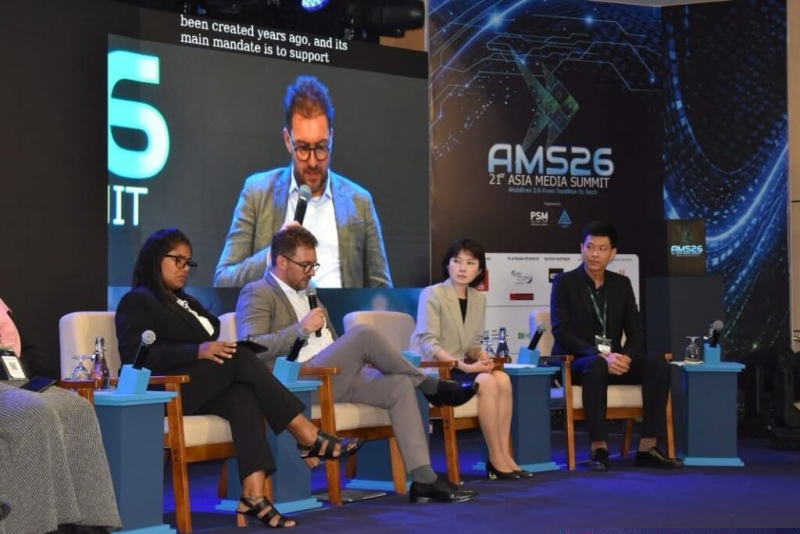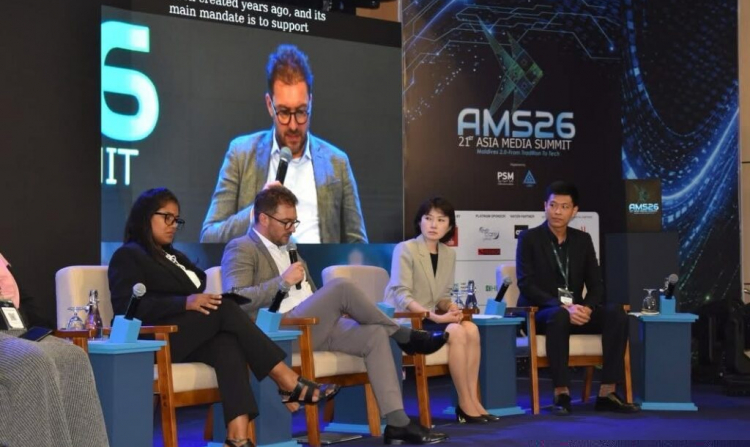
Thai PBS was invited by the Asia-Pacific Institute for Broadcasting Development (AIBD) to join a panel discussion under the topic 'Rebuilding Digital Content Ecosystem' at the Asia Media Summit 2026, hosted by Public Media Service (PMS) in the Republic of Maldives. The session sought possibilities and new practices on how traditional broadcasters can recreate their digital content ecosystems, as global legacy media is facing multi-dimensional challenges, particularly algorithm influences and transnational streaming platforms.
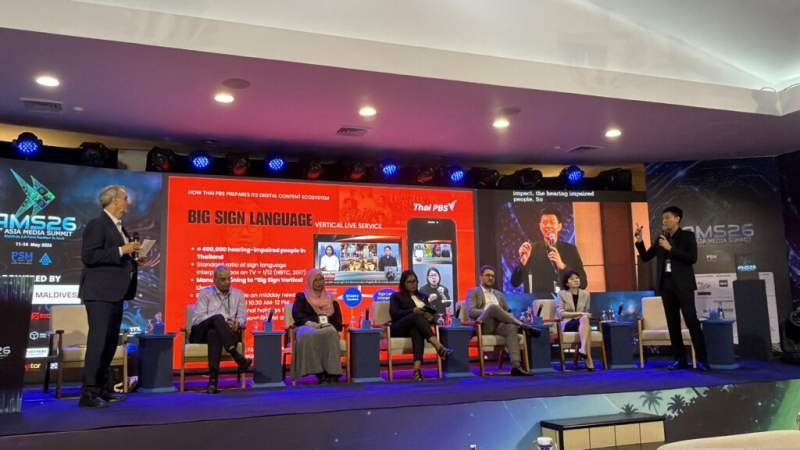
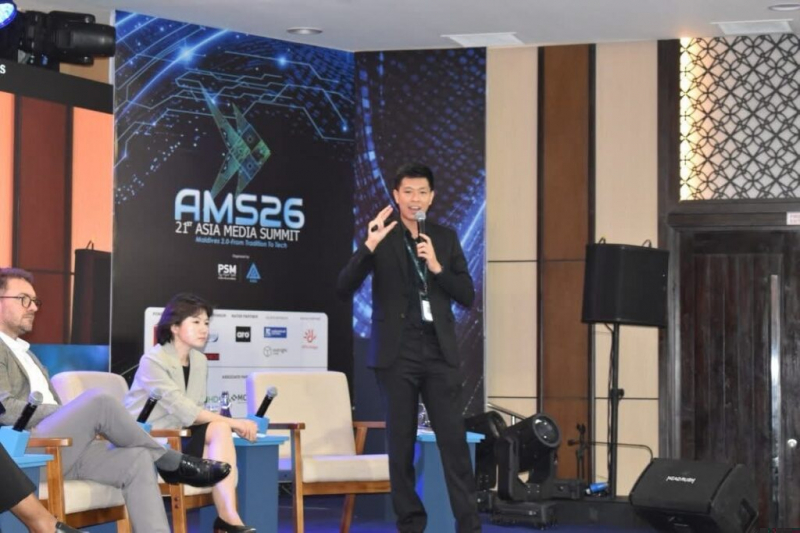
Mr. Peerachai Pasutan, Thai PBS Digital Content Creator, talked about how Thai PBS builds on its linear TV content and adjusts it to satisfy present-day online content consumption. For example, Thai PBS provides the AI Vertical LIVE streaming service: it utilizes artificial intelligence to recompose elements of horizontal, TV-format programs and display them vertically. This facilitates the public to access content anywhere and anytime on their mobiles. Another service mentioned on the stage was the Big Sign Vertical LIVE service: it allows the hearing-impaired to watch sign language interpretation on available live TV programs more clearly without flipping their devices. These examples reflect Thai PBS’s mission to produce accessible-for-all content. In any case, Mr. Peerachai emphasized human control in any AI-based services to ensure accuracy.


Mr. Gaurav Dwivedi, CEO of Prasar Bharati, pointed out that trust, inclusivity and universal access are keys to public media operations in the digital era. He mentioned multilingual digital content creation as an important approach to communicate with all groups of Indian population. For her contribution, Ms. Lee Jung-Min, Senior Director of KBS’s News and Current Affairs, spoke about how the South Korean public broadcaster integrates AI into traditional disaster coverage, enhancing both on-air and online alerts, as well as public trust. She also revealed how KBS uses its archives to produce digital-friendly video content via its KLAB unit.
In the time of fast-spreading online misinformation, Ms. Sakina binti Haji Mohamed, BERNAMA News Wire’s Editor and Head of Digital Media, stated that beyond fact-checking and AI literacy promotion, it is important to find root causes that make people share fake news. Such practice could help reduce these information threats in the digital landscape. As for Ms. Aminath Sarahath, Commissioner of the Maldives Media Broadcasting Commission, she said that public media is more crucial than ever to protect public interest through its work. She further suggested that today, a government must account for transparency and shared responsibility over full control to tackle algorithm dilemmas.
Additionally, partnerships are indispensable in developing digital-driven media, as mentioned Mr. Yoann Talhouarne, Regional Audiovisual Attaché at the Embassy of France in Singapore. The attaché talked about France’s involvements to encourage media development in ASEAN countries, such as its cooperation with AIBD and the support through CFI. Ultimately, there might be no absolute recipe behind digital transformation, but discussion, trial-and-error and integrity will help traditional media outlets adapt. At the same time, these elements contribute to credible, accurate digital content.