The Reuters Institute’s Digital News Report 2026, published by the Reuters Institute for the Study of Journalism at the University of Oxford, has revealed Thai citizens' media consumption habits and highlighted the growing role of Thai PBS as a trusted source of information in an increasingly complex media environment.
The report identifies three significant achievements by Thai PBS:
- The launch of Thai PBS Verify, a dedicated fact-checking platform
- The rise of Thai PBS News Online as one of Thailand’s leading digital news brands
- The organisation’s ability to maintain a high public trust rating of 70%, despite a broader decline in trust in news across the country
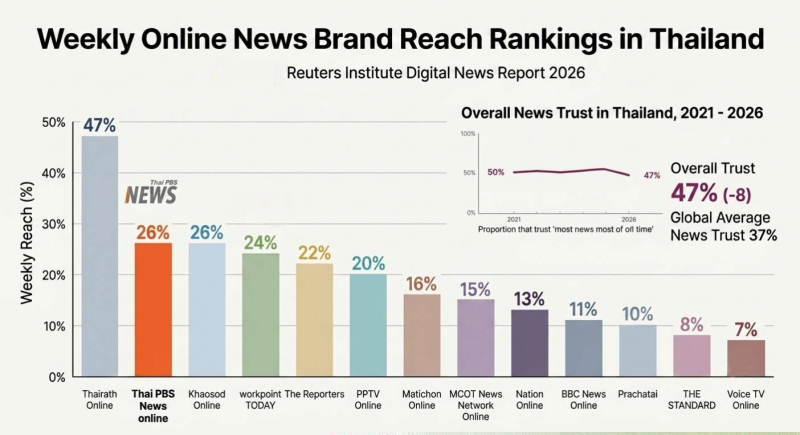
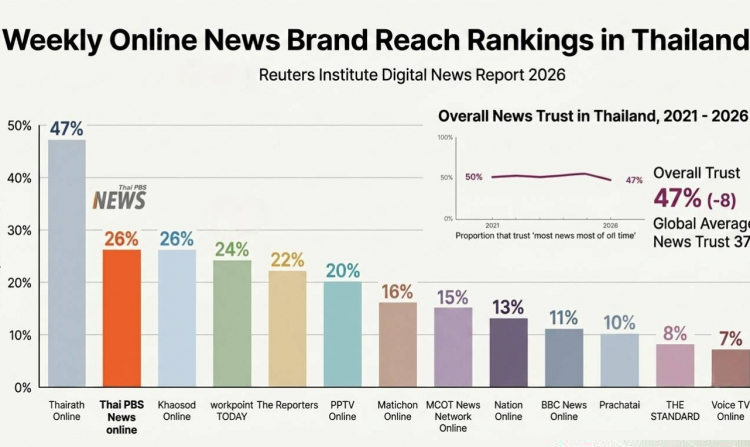
According to the report, Thailand’s media landscape continues to face growing challenges from misinformation and disinformation circulating across digital platforms. Political developments and tensions along the Thailand–Cambodia border have further intensified public uncertainty about the reliability of information. As a result, overall trust in news in Thailand declined to 47% in 2026, down from the relatively stable range of 50–55% recorded between 2021 and 2025.
Against this backdrop, the Reuters Institute highlighted Thai PBS Verify, launched in April 2025, as one of the most significant initiatives by a Thai media organisation in addressing the increasingly sophisticated challenges posed by false and misleading information. The report notes that, during the Thailand–Cambodia border tensions, inaccurate and misleading content spread rapidly across social media platforms, messaging applications and short-form video channels, leaving many people unsure of how accurate the information they received actually was. In this context, Thai PBS Verify has taken on a role beyond that of a fake-news checker, functioning instead as a fact-checking mechanism that helps filter, explain and confirm information of public interest, relying on a verification process that discloses sources, evidence and methodology so the public can access verifiable facts amid an overwhelming volume of information.
The report also highlights Thailand’s rapid transition towards digital news consumption. With internet penetration reaching 91% of the country’s 72 million population, social media has become the primary gateway to news for 78% of users, while television’s share has declined to 42%.
As consumer news behaviour shifts markedly, Thai PBS News Online has achieved a weekly reach of 26%, placing it among the country's leading online news outlets and on a par with Khaosod Online. The result demonstrates Thai PBS’s successful transformation from a traditional television broadcaster into a major digital news provider, capable of reaching audiences across multiple platforms.
The Reuters Institute report notes that trust in Thai news had remained relatively stable between 2021 and 2025, at the 50-55% level, before declining significantly to 47% in 2026, driven by the heavy spread of misinformation during major events occurring around the same period: The Thailand-Cambodia border conflict, the general election and the constitutional referendum.
At the same time, the report found that 43% of Thais avoid news, either occasionally or frequently, due to fatigue from ongoing tensions. Even so, the report shows that, despite this fatigue and the decline in overall news trust, Thai news consumers remain highly engaged. 37% reported sharing news via social media, messaging apps or email in the past seven days.
The findings further confirm that social media platforms have become the primary channels through which Thai audiences access news. Facebook remains the leading platform, followed by TikTok, YouTube and LINE, while traditional television continues to decline as a weekly source of news.
The challenge for media organisations goes beyond mere audience reach. News organisations are increasingly expected not only to report events but also to verify facts, provide context and create trusted information spaces for the public.
Mr. Vanchai Tantivitayapitak, Director General of the Thai Public Broadcasting Service (Thai PBS), said that, at a time when overall trust in news is declining, fake news is spreading rapidly. Many people access news through algorithms across various channels before reaching news organisations’ platforms. Thai PBS's key role is to serve as a trusted public news space grounded in verifiable facts.

The challenge facing media today is no longer simply a speed competition - it is now a competition for trust. Our next step is to move forward while maintaining quality news standards, expanding audience reach across every platform, in line with changing media consumption behaviour, and developing Thai PBS Verify into an even stronger fact-checking mechanism to counter misinformation, build resilience in the information space and promote media literacy across Thai society
said Mr. Vanchai
Thai PBS will continue to uphold and maintain high journalistic standards, expand our reach across platforms, in line with evolving audience behaviour, and further strengthen Thai PBS Verify as a robust fact-checking mechanism. By doing so, we aim to counter misinformation, strengthen society’s resilience against information disorder and promote media and information literacy among the Thai public.
Source: Digital News Report 2026: Thailand, Reuters Institute for the Study of Journalism, University of Oxford, published on 16th June 2026. (reutersinstitute.politics.ox.ac.uk/digital-news-report/2026/thailand)