Thai PBS is stepping up its Green Office policy with a concerted push to reduce energy consumption across all of its facilities — headquarters, transmission buildings, and terrestrial network stations nationwide. The effort is paying off: in 2025, the organisation saved over 6.45 million baht in electricity costs. With a Solar Roof project now in the pipeline across more than 30 locations nationwide, Thai PBS expects to cut costs by a further 4–5 million baht annually once the project is complete.

Director General Vanchai Tantivittayapitak said Thai PBS is firmly committed to its Green Office agenda, with a focus on using energy wisely, bringing down operational costs, and making energy-saving a natural part of everyday work life for all staff. The results speak for themselves: electricity expenditure across the organisation fell by approximately 6.45 million baht in 2025 compared to the previous year.

At headquarters, the electricity bill dropped from around 31.63 million baht in 2024 to around 28.74 million baht in 2025 — a saving of approximately 2.89 million baht, or 9.13%. The trend became more pronounced as the year went on: average monthly costs in the second half of 2025 (August–December) came to around 2.32 million baht, down from around 2.45 million baht in the first half (January–July) — a further reduction of about 5.4%.
At the Baiyok transmission building, where the station's broadcasting equipment is housed, electricity costs fell from around 2.39 million baht in 2024 to around 2.16 million baht in 2025, a saving of approximately 233,081 baht or 9.7%. The momentum has carried into 2026: electricity costs at Baiyok for January and February totalled around 335,368 baht — roughly 31,965 baht less than the same period last year.
Savings have also been recorded across Thai PBS's terrestrial network stations nationwide, where electricity costs fell from approximately 52.67 million baht in 2024 to 49.34 million baht in 2025 — a reduction of around 3.33 million baht, or 6.31%. Here too, the trend is continuing: combined network station electricity costs for January and February 2026 came to approximately 7.80 million baht, around 173,635 baht less than a year earlier.
Director General Vanchai noted that Thai PBS has encouraged all staff to play their part — switching off lights during lunch breaks, reducing power use in empty areas, and turning off computers and office equipment at the end of the day.
On the investment side, Thai PBS is moving forward with its Solar Roof project, which will see solar panels installed on the rooftops of its headquarters and more than 30 network stations across the country. The electricity generated will be used to power Thai PBS's own operations, with expected savings of around 4–5 million baht per year once fully operational.
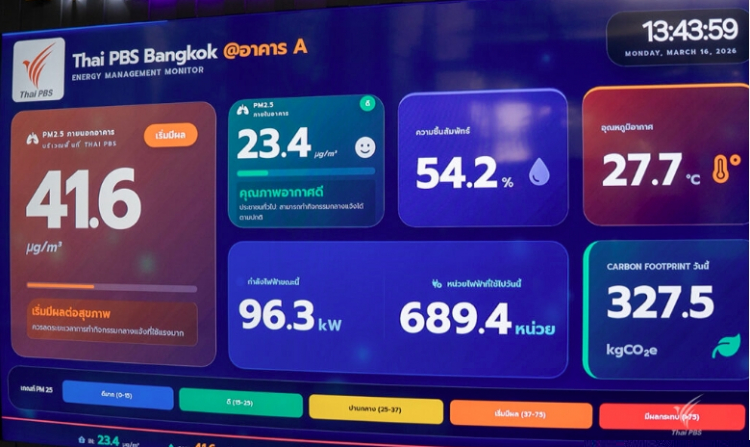
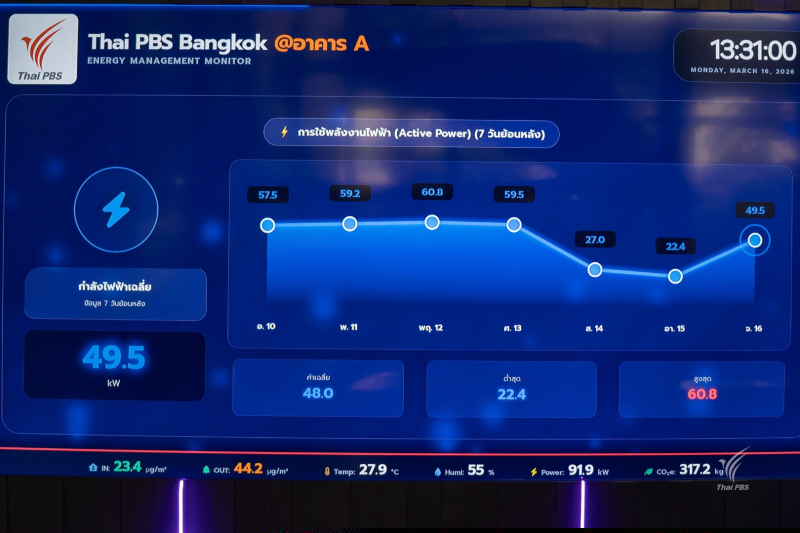
Together, these conservation measures and clean energy investments sit at the heart of Thai PBS's Green Office strategy — one built around reducing energy use, growing the share of renewables, and managing resources responsibly. To keep staff informed and engaged, Thai PBS has installed an Energy Management Monitor at Building A, which displays real-time data in a clear, accessible format: outdoor PM2.5 air quality, indoor temperature and climate conditions (air conditioning is maintained at 26°C), current electricity consumption, a rolling seven-day comparison, and a daily carbon footprint figure. Through all of this, Thai PBS is working towards its goal of becoming a public media organisation built to last — and built to do so sustainably.